Why Your Brain Remembers Some Phone Numbers (and Forgets the Rest)
July 26, 2026
The Real Reason a Number Sticks
Ask someone to recite their own phone number and most people stumble halfway through. Ask them to recite 1-800-FLOWERS and they'll get it right on the first try, years after they last dialed it. That's not a coincidence — it's how short-term memory actually works.
Cognitive scientists call it chunking: the brain doesn't store ten separate digits, it stores three or four "chunks" it can recognize as a unit. A number like 555-7000 collapses into two chunks instead of seven digits. A number like 555-1234 collapses even further, because the sequence itself is already a pattern your brain learned as a toddler.
Patterns Beat Spelling — Most of the Time
Vanity numbers that spell a word get most of the attention, but they're only one branch of a much bigger family of memorable numbers. Our automated search engine actually tracks four distinct pattern families, and word-spelling is just one of them:
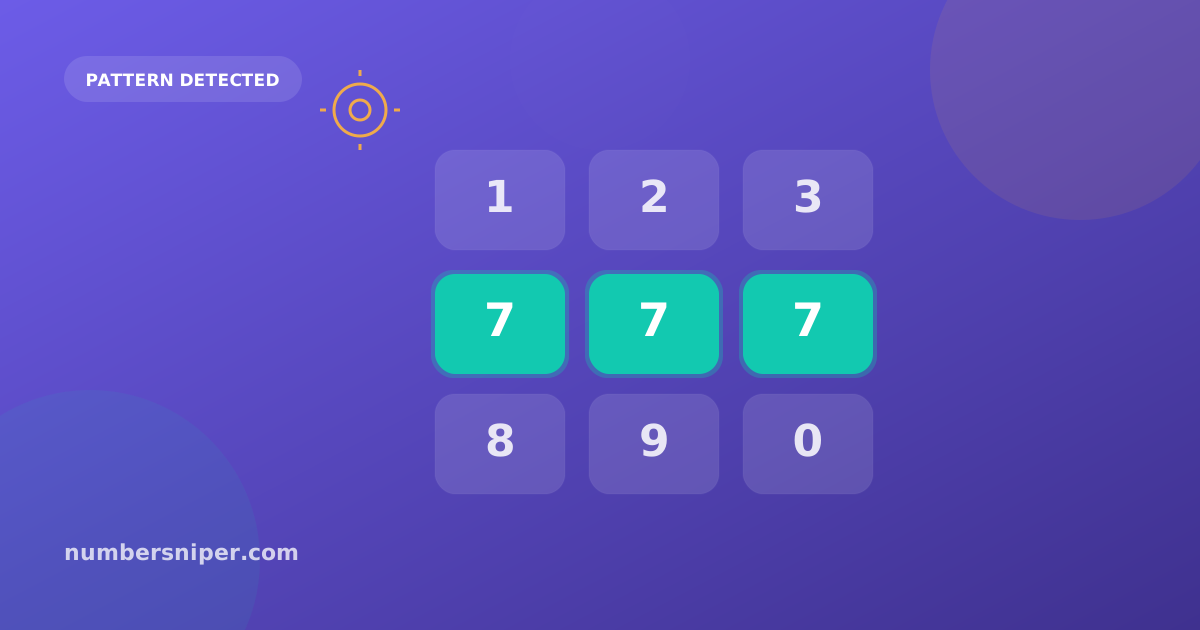
- Repeaters — the same digit shows up in a tight cluster (555-7777, or a number ending in 0000). Nothing to decode, nothing to spell — the eye catches it instantly.
- Sequences — ascending or descending runs like 234-5678 or 987-6543. Your brain doesn't memorize these; it recognizes them as a single idea, the way you recognize the alphabet.
- Mirrors and alternators — numbers like 512-1521 or 480-4804 that fold back on themselves. These read almost like a jingle when you say them out loud.
- Keypad words — the classic vanity number, where the digits spell something on a phone dial. Powerful, but only when the word is short and the mapping is obvious.
A number doesn't have to spell a word to be unforgettable. It just has to break the pattern of "random digits" in a way your brain notices.
Why Hunting for These Manually Doesn't Work
The problem with all four pattern types above is timing, not taste. Carriers release inventory constantly — someone cancels service, a business closes, a number gets recycled back into the pool — and the good patterns get grabbed within minutes, often by other automated buyers. By the time a number shows up in a manual search on a carrier's own site, the interesting ones are already gone.
That's the entire reason our engine runs around the clock instead of publishing a static list. It watches area codes continuously, scores every new number the instant it appears using the same four pattern families above, and grabs the ones worth having before a human would even see the listing. What lands in the catalog isn't "everything available" — it's already been filtered down to the numbers that pass the pattern test.
Picking One for Your Business
A few practical rules, independent of which pattern type you go with:
- Say it out loud to three people who've never seen it written down. If two of them repeat it back correctly, it's a keeper.
- Match the area code to where your customers actually are — a memorable number with the wrong area code just adds a second thing people have to double-check.
- Don't stack patterns. A number that's both a sequence and a near-word is trying to do too much; simpler almost always wins.
Browse today's catalog to see all four pattern families in action — a fresh batch gets sniped every day.